

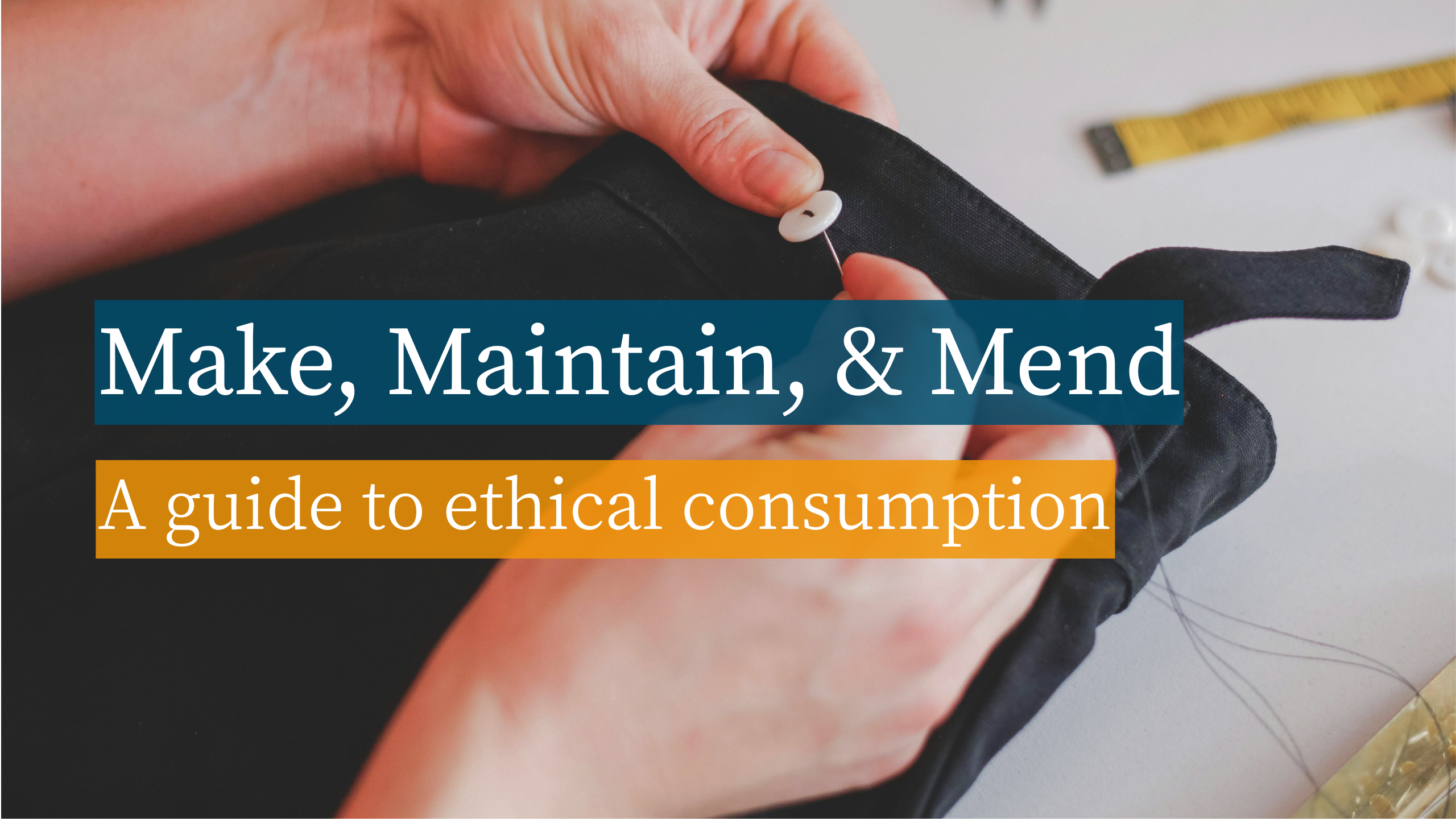
Take responsibility for your stuff and make your items last.
Over the past few years, I’ve noticed a shift in how I think about stuff. In an effort toward ethical consumption, I’ve become more conscious about what items I bring into my home, and the items that already live there.
And I’m not the only one. All over social media, people are waking up to the idea that overconsumption is… not great. But this is nothing new. People have been sharing concerns about consumption and its effects on the planet for generations.
While I’ve always agreed that we should be more mindful and had done what I (believed) could, ideas like zero waste living or underconsumption core always seemed too complicated, oversimplified, or unrealistic. It wasn’t until I adopted the “make, maintain, & mend” mindset that things began to click.

Table of Contents
-
Make What You Can.
- Skills
- Access
- Customizability
- Quality Control
- Pride
-
Maintain things when needed.
- Overcome Overconsumption
- Personal Interest
- Invest
-
Mend it if possible.
- Benefits
- Mending Considerations
- Construction
- Do what you can.
Make What You Can.
There will always be some things beyond our ability to make and others that don’t make logical sense to try to produce ourselves. Thankfully, we have a society to fulfill those needs. But there are plenty of things we can make, and we can take the time to learn to make even more.
For me, this shift in thinking first started when I started learning how to sew; for others, it might come from cooking from scratch, crafting, engineering, or any other form of making the stuff you want and need.
There are some pretty great benefits that come with making your own things.

Skills
You get to learn new skills when you start making your own stuff. Of course, there are the direct skills used in making an item, but those skills are often transferable and can help you expand the list of items you can make for yourself. For example, if you make your food from scratch, it’s not too big of a stretch to start making your own cleaning, hygiene, and skin and hair care products.
Access
Whenever you need more of an item you’ve made, you know you can make it again. If you need something in a pinch, you can always count on yourself to make what you want, so long as you have the raw materials.
Also, if we ever face another incident of supply chain issues (like we did during the pandemic in the early 2020s), or worse, you can not only ensure that you are taken care of, but you can also serve your community by making and selling or donating that item to other people.
Customizability
One of the intrinsic benefits of making your stuff is that you can make it or change it however you’d like.
Don’t like the color something comes in? Make it yourself, and you can pick the exact color you like best! Something doesn’t fit quite right? Make it yourself, and you can adjust the size for a perfect fit!

You can customize pre-made patterns and plans or do what I usually do and make your own! You’ll begin to understand fundamentally how items are made as you spend more time and gain more experience making your items.
Quality Control
When you make your things, you get to choose the quality of materials and the methods of production. You don’t have to hope that you aren’t getting an inferior product because the manufacturers and distributors are cutting corners to save a few dollars.
Of course, if you are buying materials, ingredients, and parts to make your items, you still have to be mindful of where you’re getting those things, but you can know for sure that the work you put into making whatever it is you can make will be up to your standards.
You can also be sure that the work you’re putting into creating your items is done ethically, enriching yourself through self-satisfaction instead of the pockets of exploitative companies and corporations.
Pride
I absolutely love the feeling when I finish a project and get to bask in the fruit of my labor. There is something so satisfying about completing a project, sharing it with family and friends (or the internet), and getting to say, “Hey, guess what! I made that!”
Beyond that joy, there is a quiet but potent sense of pride that sits deep within me, at the tangible proof that I am capable of transforming ingredients and materials into something really cool.
Maintain things when needed.
If you have an item you love, whether you’re the original maker or not, it is so important to learn how to maintain it properly. Just think about how much use and pleasure we can get from our favorite things if they last a good, long while. I know so many items are made to be disposable nowadays, but there are some serious benefits to moving away from the single-use consumption lifestyle and taking care of what you own.
Overcome Overconsumption

Overconsumption is a major issue today. Whether you’re looking at it from an economic perspective, focusing on financial responsibility, or from an ecological perspective concerning what is healthy for our planet, in almost every case, it’s best to reuse whatever we already have.
The production and disposal of our products are rapidly degrading our environment, so not participating in either process for as long as possible is a great way to do our part.
However, maintaining our items so they last is not great for companies that are constantly trying to sell us new stuff that we don’t need. It seems like every day, I’m seeing hauls and “collections” full of overconsumption from people who buy stuff seemingly just for the sake of buying stuff.
To combat that, we can be mindful of what we actually bring into our possession.
Personal Interest
It’s especially common for us to properly care for the things we own if we’ve taken the time and effort to make the item in the first place. After you’ve put in all that work to make something, it would be pretty silly to put all that effort to waste by not taking care of it.
Some of this will come naturally because you’ve already invested in the item by making it so you’ll treat it better. It’s like how people tend to treat their own cars better than a rental because they have a vested interest in making sure their vehicle lasts a while.

But proper maintenance also comes from learning how best to care for something. Cleaning things properly, checking parts for wear and tear, conditioning and oiling moving parts; whatever maintenance something requires, taking the time to perform those tasks every once in a while will not only make them last longer but also make them look and perform better!
Invest
This philosophy is great for artists and crafters who make things, but it can also apply to items you buy. Whether it’s raw materials or a finished product, keeping maintenance in mind is still important.
When it comes to materials, consider what work will have to go into maintaining a completed piece. If you plan to knit a sweater but you don’t have the time and patience to take care of cashmere, don’t buy cashmere yarn.
But if you do choose to invest in cashmere yarn and intend to care for the sweater in the way it needs, the money you spend on that yarn will be worth it because you know that piece will last a lifetime.
More money doesn’t always mean better quality, but parts and materials manufactured at the lowest cost possible often trade quality and durability for their low price point. If the quality of the material is too low, the item made from that material might fail (regardless of how well you try to maintain it). However, if you are willing to invest in quality materials, maintaining your projects can make a big difference.

You can also feel confident investing in something pre-made if it can be well-maintained. Let’s say you purchase a blender as an example. If you’re able to properly take care of the blender to ensure it lasts forever, clean it and oil the moving parts so the engine doesn’t burn out, then you can feel more comfortable purchasing a more expensive, better-performing model. It would be a one-time investment.

The alternative is buying a cheap blender every few years, which, comparatively, might cost you more by the end of the better blender’s potential life span. It’s likely that you won’t take as good care of a cheaper, poor-quality blender if you know you’ll have to buy another one regardless of your maintenance.
Mend it if possible.

So much of what we own is thought of as disposable. Mending our items is an often overlooked part of how we use our stuff. If something breaks or is damaged, a lot of our first reaction is to just toss it.
Benefits
Learning to mend what we own can amplify your shift into a more ethical consumer exponentially. Through mending your things, you will learn new skills, be less damaging to the environment, have a sense of pride in your work, and make your stuff last longer.
Mending Considerations
Keep mending in mind when making or buying a quality piece. Can the finished item be mended at all? Before shifting my mindset, I wouldn’t even think of checking this. But in doing so now, I’ve realized that many items made today are intentionally designed, so they can’t be fixed (or are very difficult to fix).
Think of all the controversy that certain electronic companies are creating because they are making their products in such a way that repair techs would need expensive and very specialized tools to do basic repairs if those repairs were at all possible.
This is done intentionally so the companies can make more money by either cornering the market on repairs or by making it more of a hassle so you just buy a new product instead.
If you don’t want to fall victim to this, keep repairs in mind when getting new items.
Construction
If you are able to mend your things yourself, a hidden benefit is that you’ll develop a better understanding of how something is made. Taking something apart, fixing it, and putting it back together is how a lot of engineers and technicians learned to love making things themselves. It’s a great teacher, but maybe look up a YouTube tutorial before you completely disassemble your microwave or seam rip your favorite pair of jeans!

Cost savings
If you can fix something instead of buying new, 9 times out of 10, that will be the more affordable option. Only paying for a replacement for the damaged part instead of replacing perfectly fine pieces is not only cost-effective but more efficient, too. If you learn to fix your items yourself, you will only have to pay for the damaged part and can save on other pieces and labor.
Do what you can.
I know there are some things that are too impractical to make, maintain, or mend yourself. The technology might be too advanced, the materials might be inaccessible, or it might be too costly if you’re not producing items on a large scale. Making, maintaining, and mending won’t likely be an option for everything and at every time. That’s ok.
Instead of trying for an impossible level of perfection, which leads to you doing nothing because of being overwhelmed and burnt out, do what you can.

The best thing you can do to become a more ethical consumer is to shift your mindset. Once you get started, I bet you’ll find that doing “what you can” covers much more than what you first think. You’ll start seeing new opportunities to use your new skills, and before you know it, you will have built shopping and practical habits that align with your values.
What is your next making, maintaining, or mending project?
Do you have any tips to add?
Comment below, and let’s be better consumers together!
